Gas Chromatography-Mass Spectrometry (GC-MS)
Gas Chromatography-Mass Spectrometry is the combination of gas chromatography (GC), used to separate volatile and semi-volatile organic compounds, with mass spectrometry (MS) to determine the mass-to-charge ratio (m/z) of an ionized product, enabling identification. GC-MS analysis is particularly useful for identifying and quantifying small, organic molecules in complex mixtures. Covalent’s capabilities include a state-of-the-art TOF-GC-MS with exceptional mass accuracy and sensitivity and offer a variety of injection and ionization modes.
What Is Gas Chromatography-Mass Spectrometry (GC-MS)?
A combination of multiple techniques, GC-MS analysis is particularly useful for identifying and quantifying small, organic molecules in complex mixtures. To enable gas chromatography, samples must be injected directly in the gas phase or transformed to the gas phase via liquid injection, headspace analysis, solid-phase microextraction (SPME), thermal desorption (TD), pyrolysis, evolved gas analysis (EGA) or field desorption (FD), all of which are supported by Covalent’s state-of-the art laboratory.
After exiting the gas chromatograph, compounds must be ionized for analysis and detection. Covalent supports several modes of either hard or soft ionization, including electron ionization, chemical ionization, field ionization, field desorption, and photoionization.
Finally, ions are separated and counted. Depending on the specific application typical mass analyzers include Single Quadrupole (SQ-MS), Triple Quadrupole (TQ-MS) or Time-Of-Flight (TOF) analysis, which allows for significantly improved mass accuracy over quadrupole systems and simplifies the collection of a wide range of m/z without sacrificing sensitivity.
Other Details:
- Seven available injection methods.
- Five available ionization modes.
- Three available mass analyzers including state-of-the-art TOF GC-MS.
- Ideal for all volatile and semi-volatile organic compounds.
Working Principle
Samples injected into a gas chromatographer (GC) are volatilized and swept through a separatory column by an inert carrier gas – usually helium, hydrogen, argon or nitrogen. Compounds separate along the length of the column based on their affinity for the column, and a well-designed method will fully separate all compounds into a mixture. Upon exiting the column, compounds are ionized and transferred to a mass spectrometer (MS), where the generated ions are separated and counted.
Analytical Depth
Intensity of characteristic ions generated by volatile and semi-volatileorganic compounds.
Material Compatibility
Organic mixtures, gases, solids and liquids containing volatile organics, polymers.
Mass Accuracy
Delivers 1 ppm precision to confidently identify compounds at trace levels.
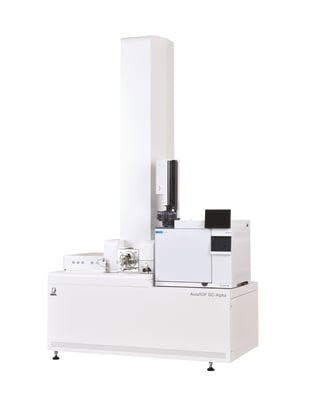
Equipment Used for GC-MS:
JEOL JMS-T2000 AccuTOF GC-Alpha GC-MS
- Integrated NIST library search software for analyte identification.
- Inert electron ionization source.
- Temperature Range: 150 to 300°C.
- High Sensitivity: Instrument detection limit (IDL) = 18.7 fg.
- Wide Dynamic Range: 4 Orders.
- Wide Mass Range: ~m/z 6,000.
- High Mass Resolving Power: 30,000.
- High Mass Accuracy: to 1 ppm.
Unsure Whether GC-MS Is Right for You?
Covalent’s expert team can help understand your sample characteristics and testing needs to craft a solution to your situation.
Talk to an ExpertKey Differentiators
Strengths
Limitations
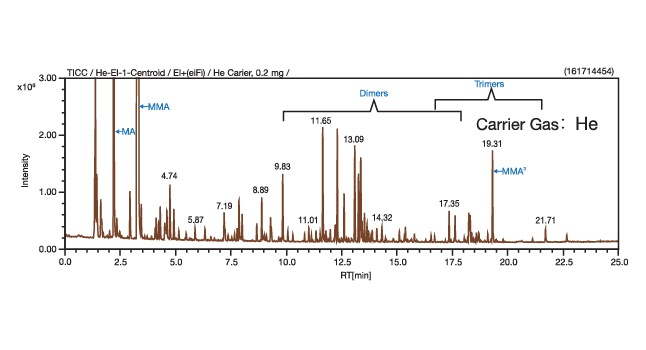
Above image shows a chromatogram of an acrylic resin analyzed by Py-GCMS (Pyrolysis-Gas Chromatography-Mass Spectrometry). Well-separated peaks show the primary monomers (MA and MMA) and larger pyrolysis fragments including dimers and trimers.
What we accept:
Gases, liquids and solids are acceptable depending on specific matrix and measurement goals. GC-MS analysis techniques are compatible with small sample volume or mass; measured analyes are typical on the order of nanograms. Analytes must be volatile below 300°C.
Why Choose Covalent for Your GC-MS Needs?
Learn More About Using Gas Chromatography-Mass Spectrometry Today!
Contact Us