Skip to content

Scanning Electron Microscopy (SEM)

SEM scans surfaces with electrons to image topography and composition at sub‑nanometer resolution and depth.


Get Expert Analysis of Your Material

What Is Scanning Electron Microscopy (SEM)?

Scanning electron microscopy (SEM) is an analytical technique that produces an image of a sample and other signals by scanning the surface with a high energy beam of electrons. The electron beam interacts with the atoms of the sample to produce many different signals that contain detailed information including the surface topography and chemical composition of the sample.
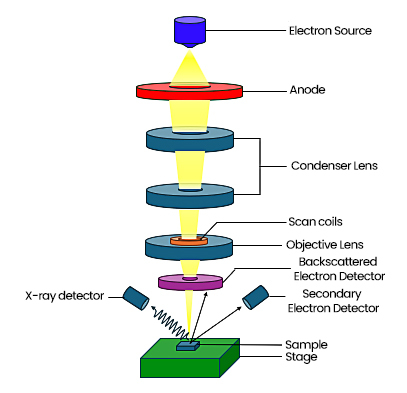
electron-microscopeThis schematic describes the major components of a scanning electron microscope.


Working Principle

SEM provides the user with the ability to see and capture images of the morphology of sample surfaces to visually identify key features and areas of interest.

Accelerated Research and Development

Accelerated Research and Development

Delivers nanoscale insights that drive innovation and material optimization.

Improved Quality Control

Improved Quality Control

Identifies defects, contaminants, and compositional issues to enhance product reliability.

Rapid and Actionable Results

Rapid and Actionable Results

Provides high-quality imaging and elemental analysis with fast turnaround times.
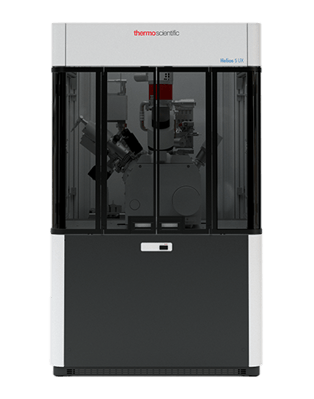
Equipments Used for SEM:

Thermo Scientific Helios 5 UC DualBeam FIB‑SEM

  • Electron column: Elstar Extreme high-resolution field-emission SEM column with Magnetic immersion lens.
  • Electron beam: Accelerating voltage 350 V–30 kV; resolution 0.6 nm at 15–30 kV and 0.7 nm at 1 kV.
  • Source: High-stability Schottky FEG delivering ~0.8 pA–100 nA probe current.
  • Detectors: In-lens SE/BSE (TLD), ETD SE, optional in-column SE/BSE/MD, DBS, and retractable STEM 3+ BF/DF/HAADF.
  • Stage: High-precision 5-axis motorized stage (up to 150 × 150 mm XY).
Thermo-Scientific-Helios-5-UC-DualBeam-FIB‑SEM

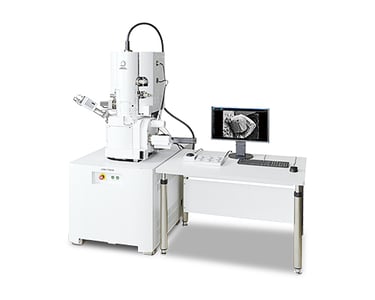
JEOL JSM‑IT800HL Schottky FEG SEM

  • Electron gun: In-lens Schottky Plus field-emission gun with probe currents up to 300 nA at 30 kV.
  • Electron beam: Landing voltage 0.01–30 kV; resolution 0.7 nm at 20 kV and 1.3 nm at 1 kV.
  • Objective: Hybrid Lens for versatile high-resolution imaging.
  • Detectors: Standard SED and UED; optional SBED and segmented VBED for compositional and topographic contrast.
  • Stage: Full eucentric 5-axis motorized goniometer stage (up to 170 mm-diameter samples).
JEOL-JSM‑IT800HL-Schottky-FEG-SEM
AdobeStock_110718477

Unsure Whether SEM Is Right for You?

We provide industry-leading, high-resolution scanning electron microscopy capabilities that offer superior data essential for understanding and optimizing the quality of your materials.

Talk to an Expert
Key Differentiators

  • EDS on multiple tools.
  • EBSD on Helios 5 UC.
  • Low vacuum/environmental mode on Scios.
  • Multiple tools with ultra-high resolution (UHR) immersion final objective lens.
  • Electrostatic final objective lens for magnetic materials on Scios.
  • Air free transfer module compatible with JEOL IT-800HL.
  • 150mm X-Y stage range.
  • 3D reconstruction capability with Thermo Fisher Slice and View feature and Aviso software.

Strengths

High spatial resolution.
Excellent surface topography and depth of field.
Wide range of magnification.
Ability to perform elemental/compositional analysis.
Multiple imaging modes, flexible sample size and geometry.
Rapid imaging capabilities.

Limitations

Samples analyzed with SEM are done under a high vacuum environment and therefore must be vacuum stable.
Liquids or volatile outgassing materials are not compatible with SEM.
Magnetic materials can be analyzed with appropriate caution.
Magnetic samples in ultra-high-resolution mode are avoided to avoid damaging the instrument.
Example Output
Sample Requirements

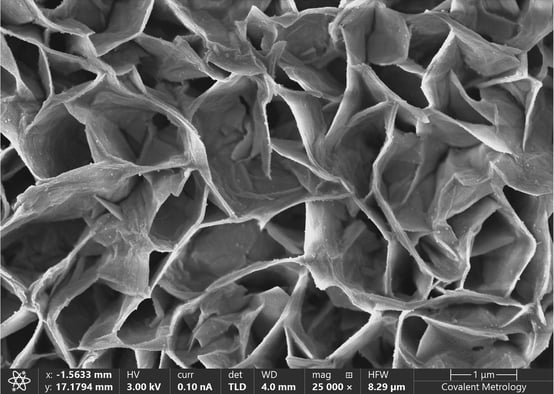
High resolution, secondary electron image of a grown thin film layer on a metallic substrate. The large depth of field in SEM allows the 3D topography of the thin film layer to be highlighted.

scanning-electron-microscopy-output1

What we accept:

  • Solid state samples required including thin films on substrates, powder samples, bulk samples.
  • Must be vacuum compatible, no outgassing, volatile samples.
  • Electrically conductive samples. Non-conductive samples will require additional preparation to apply a conductive coating.
  • Samples should be thermally and mechanically stable under vacuum conditions and beam exposure. Need to be mounted to the stage or aluminum stubs with conductive tape or other adhesives.
  • Samples need to be large enough to be easily manipulated with physical tools such as tweezers or powder scoops.
  • Minimum detectable concentration with EDS is 0.1 atomic percent.
  • Samples with significant variations in height may not be compatible especially for SEMs that have a short optimal working distance. This is especially true when FIB milling is also required.
  • Samples requiring FIB milling should generally be flat and the area of interest on the top most surface of the sample. Some exceptions can be made depending on the geometry of the sample.
  • Sample size, shape and weight are important considerations for sample mounting and orientation for SEM analysis and FIB milling. Samples need to be mechanically stable and not drift while the stage is tilted during FIB milling. Specialized sample holders and fixtures may be required for complex samples.

Why Choose Covalent for Your SEM Needs?

Our clients trust Covalent Metrology for SEM analysis results that exceed their expectations. We provide industry-leading, high-resolution scanning electron microscopy capabilities that offer superior data essential for understanding and optimizing the quality of your materials.

Learn More About Using Scanning Electron Microscopy Today!

Contact Us

AdobeStock_637058251