Tensile Testing
Tensile testing is a mechanical testing method used to measure how a material behaves under axial stretching (tension). It determines key properties such as tensile strength, yield strength, elongation, and modulus of elasticity.
These parameters are critical for understanding how a material will perform under mechanical load in real-world applications.
What Is Tensile Testing?
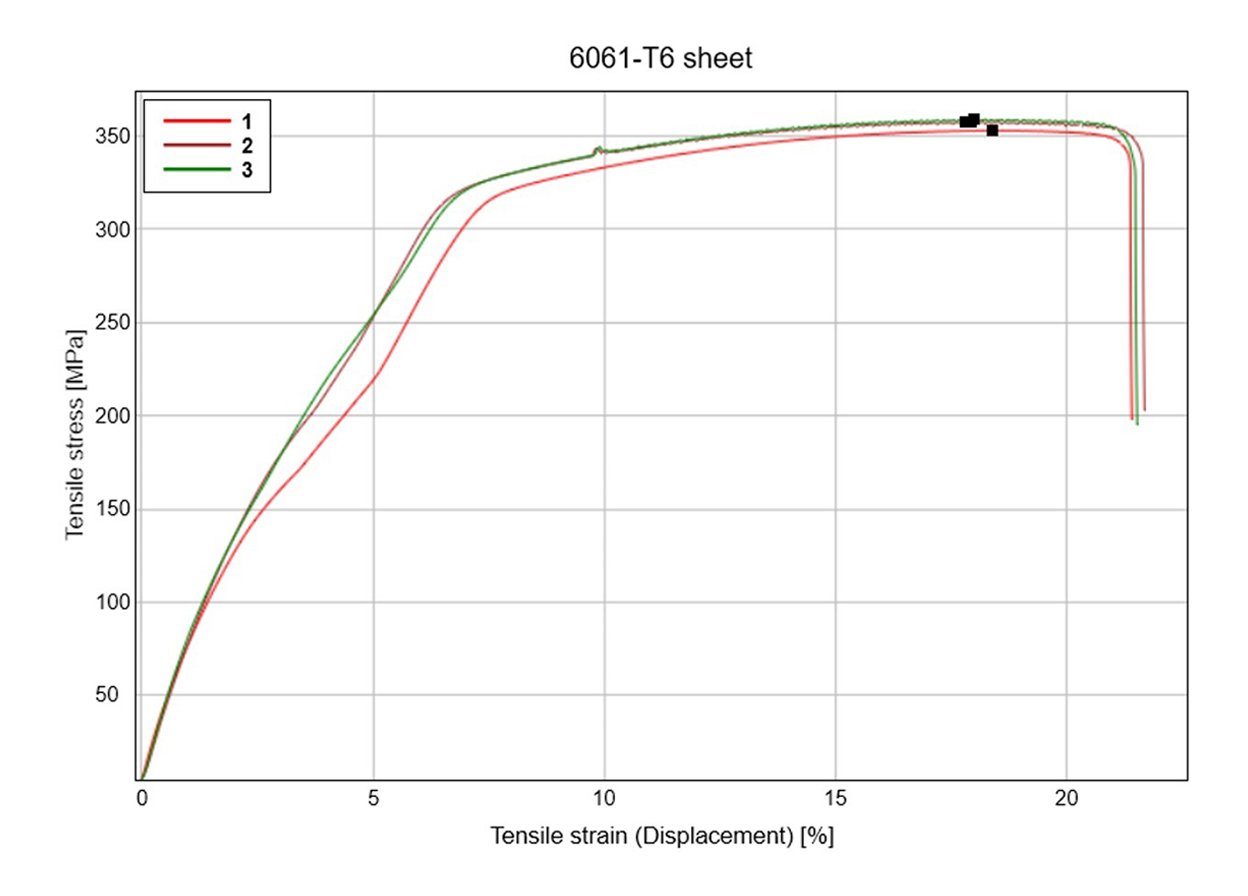
Tensile testing, also known as mechanical testing or pull testing, is where a specimen is gripped at both ends and pulled at a controlled rate until it either yields or breaks. The machine records the force applied and the extension of the sample, producing a stress-strain curve that quantifies the material’s mechanical response.
Tensile testing is foundational to materials science and engineering, supporting quality control, product validation, research and development, and regulatory compliance across diverse industries.
Working Principle
A tensile test begins by mounting the sample in two grips of a universal testing machine (UTM), such as an Instron. The machine pulls the sample at a controlled rate until it fractures. During this process, force and displacement are recorded and converted into engineering stress and strain.
Depending on the material and the standard, extensometers or video strain measurement systems may be used to capture precise strain data. The resulting stress-strain curve provides key mechanical properties, including ultimate tensile strength (UTS), yield point, elongation at break, and modulus. For precise strain measurements, we use a non-contact Advanced Video Extensometer (Instron AVE 3).
Test conditions such as speed, grip type, gauge length, and temperature are carefully controlled and standardized (e.g., ASTM D638 for plastics, ASTM E8 for metals).
Assesses Material Integrity
Provides standardized evaluation of mechanical performance for R&D, quality control, and certification.
Supports Design and Simulation
Determines Young’s modulus and stress-strain behavior critical for engineering and product development.
Validates Environmental and Supplier Claims
Evaluates effects of heat, aging, and verifies compliance with material specifications.
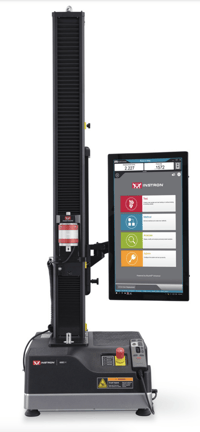
Equipment Used for Tensile Testing:
Instron 68SC-5 Universal Testing Machine
- High-resolution load cell with ±0.5% accuracy to 1/1000 of capacity.
- Bluehill Universal software with auto-positioning, QuickTest mode, and customizable workflows.
- Interchangeable grips and flexural/compression fixtures.
- Advanced safety features including Specimen Protect and fine-position controls.
- Enables support of ASTM and ISO tensile, compression, and flexural test standards.
- Extensometry: Instron AVE 3 Advanced Video Extensometer (non-contact), compliant with ASTM E83/ISO 9513.
Unsure Whether Tensile Testing Is Right for You?
Understanding the mechanical strength of covalent materials is crucial for application in various fields. Learn more about using Tensile testing services today.
Talk to an ExpertKey Differentiators
- Analytical Output: Stress-strain curves; ultimate tensile strength (UTS), yield strength, modulus of elasticity, elongation at break, energy to fracture, and flexural/compressive load response, tenacity.
- Detection Limits: Load resolution down to 1/1000th of load cell capacity (±0.5% of reading); Covalent carries 50 N, 500 N, and 5 kN load cells.
- Material Compatibility: Rigid and semi-rigid plastics, films, elastomers, adhesives, foams, composites, fibers, and low-strength metals.
- Force Range: Up to 5 kN (1,125 lbf); load cells with built-in overload protection.
- Strain Measurement: AVE 3 Video extensometer.
- Temperature Range: Ambient only (no integrated heating or cooling chamber).
- Grip Options:
- Screw-action grips (general-purpose).
- Pneumatic grips (250 N rated) for delicate films and thin substrates.
- Precision specimen loader for accurate mounting of soft materials and fibers.
- Flexural and Compression Fixtures:
- 150 mm compression platen for foam, rubber, or soft materials.
- 3-point and 4-point bend fixtures for standardized flexural testing.
- Travel Range: 868 mm.
- Test Speed: 0.001 mm/min to 2540 mm/min.
Strengths
Limitations
Stress-strain curves of 6061-T6 aluminum
What we accept:
- Physical Form: Dogbone-shaped specimens (plastics/metals), rectangular strips (films), discs, or other standardized shapes.
- Geometry: Prepared according to relevant standard (e.g., ASTM D638 Type I).
- Sample Size: Tensile specimens are generally 5 mm thick and ≤25 mm wide.
- Special Requirements: Fibers or delicate specimens should be provided in sufficient length (≥100 mm) for alignment and secure mounting.
Why Choose Covalent for Your Tensile Testing Needs?
Learn More About Using Tensile Testing Today!
Contact Us