Thermogravimetric Analysis (TGA)
Thermogravimetric Analysis (TGA) is a thermal analysis technique that measures changes in a material’s mass as a function of temperature or time under a controlled atmosphere. It is widely used to characterize material composition, thermal stability, and decomposition behavior.
What Is Thermogravimetric Analysis (TGA)?
TGA provides critical insight into a material’s thermal behavior and composition in a single test. It allows for identification of moisture content, volatiles, organic vs. inorganic content, and thermal degradation points. This technique delivers high-resolution, quantitative data ideal for material screening, formulation studies, quality control, and material analysis.
Working Principle
A sample is placed on a high-precision mass balance inside a temperature-controlled furnace. As the temperature increases (or is held constant), the system records any change in the sample's mass. The analysis is performed under inert or reactive gases (e.g., nitrogen or air) to understand thermal events such as evaporation, decomposition, or oxidation.
Assess Thermal Stability and Degradation
Tracks mass changes to evaluate material decomposition, moisture, volatiles, or ash content.
Quantitative Composition Analysis
Determines filler/resin content, residual solvents, or polymer lifetime through decomposition kinetics.
Small Sample and High-Resolution Data
Requires only 10–50 mg of sample, ideal for formulation studies, quality control, and research applications.
Equipment Used for TGA:
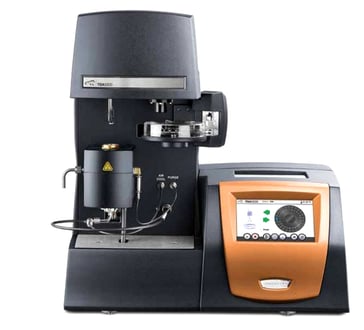
Covalent has a TA Instruments TGA 5500, the most advanced TGA, offering 0.1 µg balance resolution. This allows us to detect even the smallest material changes with exceptional accuracy.
TA Instruments TGA 5500
- Mass Sensitivity: 0.1 µg.
- Temperature Range: Ambient to 1200 °C.
- Controlled Heating Rate (up to 1000 °C): 0.1 to 500 °C / min.
- Nitrogen and Air Atmosphere.
Unsure Whether TGA Is Right for You?
Whether you’re looking for fast troubleshooting or ongoing support, Covalent’s TGA services are scalable solutions to meet your needs.
Talk to an ExpertKey Differentiators
- Features ultra-sensitive balance and programmable dual gas switching.
- Capable of high throughput runs with autosampler.
Differentiates Covalent from competitors through advanced gas switching, controlled environments, and integration with FTIR, GC-MS for evolved gas analysis (on request).
Strengths
Limitations
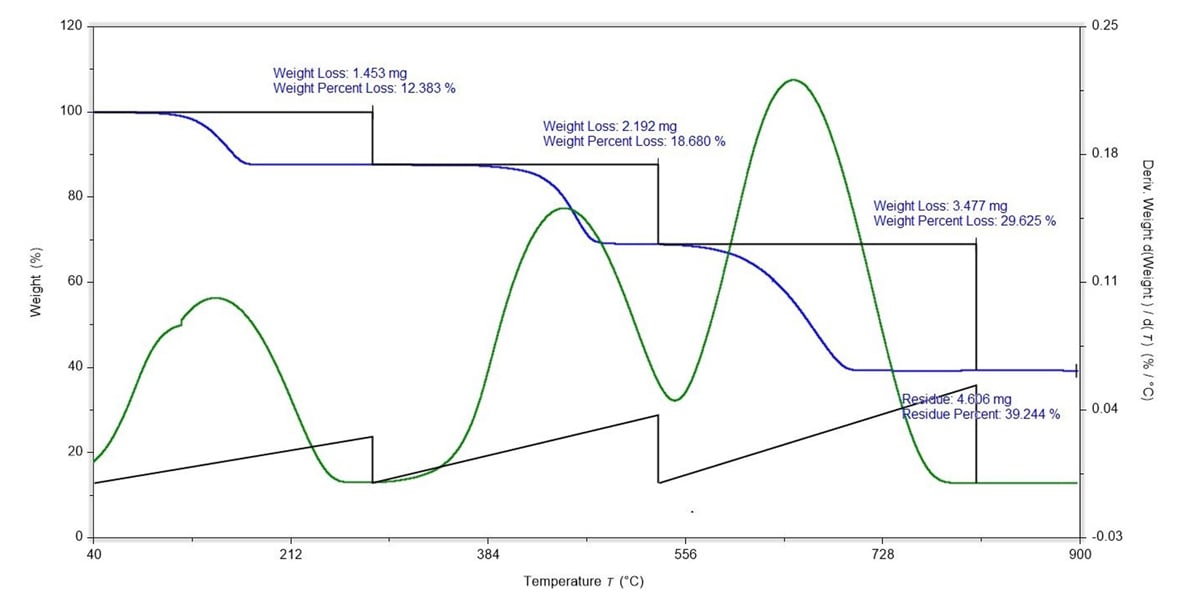
Thermogravimetric analysis (TGA) of calcium oxalate monohydrate.
What we accept:
- Physical Form: Solids or semi-solids; powders, films, pellets, pastes.
- Volatility/Thermal Stability: Should be stable enough to handle programmed heating.
- Sample Size: Typically, 10–50 mg.
- Special Requirements: Must be dry or pre-conditioned unless moisture is being analyzed. Inert atmosphere recommended for sensitive organics.
Why Choose Covalent for Your TGA Needs?
Learn More About Using Thermogravimetric Analysis Today!
Contact Us