X-ray Photoelectron Spectroscopy (XPS)
XPS measures surface elemental composition and chemical states within ~7–10 nm, enabling angle-resolved and depth profiling.
What Is X-ray Photoelectron Spectroscopy (XPS)?
X-ray Photoelectron Spectroscopy (XPS), also known as Electron Spectroscopy for Chemical Analysis (ESCA), is a surface-sensitive analytical technique that probes the top 70–100 Å of a sample. The technique is based on photoelectrons emitted from atoms on the sample surface after excitation by x-rays, usually Al K-alpha (1487 eV).
The key strength of XPS is its surface sensitivity. The mean free path of the emitted photoelectrons limits the depth from which they can escape and be detected to the top 70 – 100Å of the surface using the typical Take-off-Angle (TOA, measured between the detector and the surface) of 90° and depending on the element from which the electron originated. Changing this TOA to a more grazing angle can reduce the analytical depth. This makes XPS the ideal technique for the analysis of thin films, surface contaminants, and oxidation/corrosion.
Working Principle
- Elemental Composition:
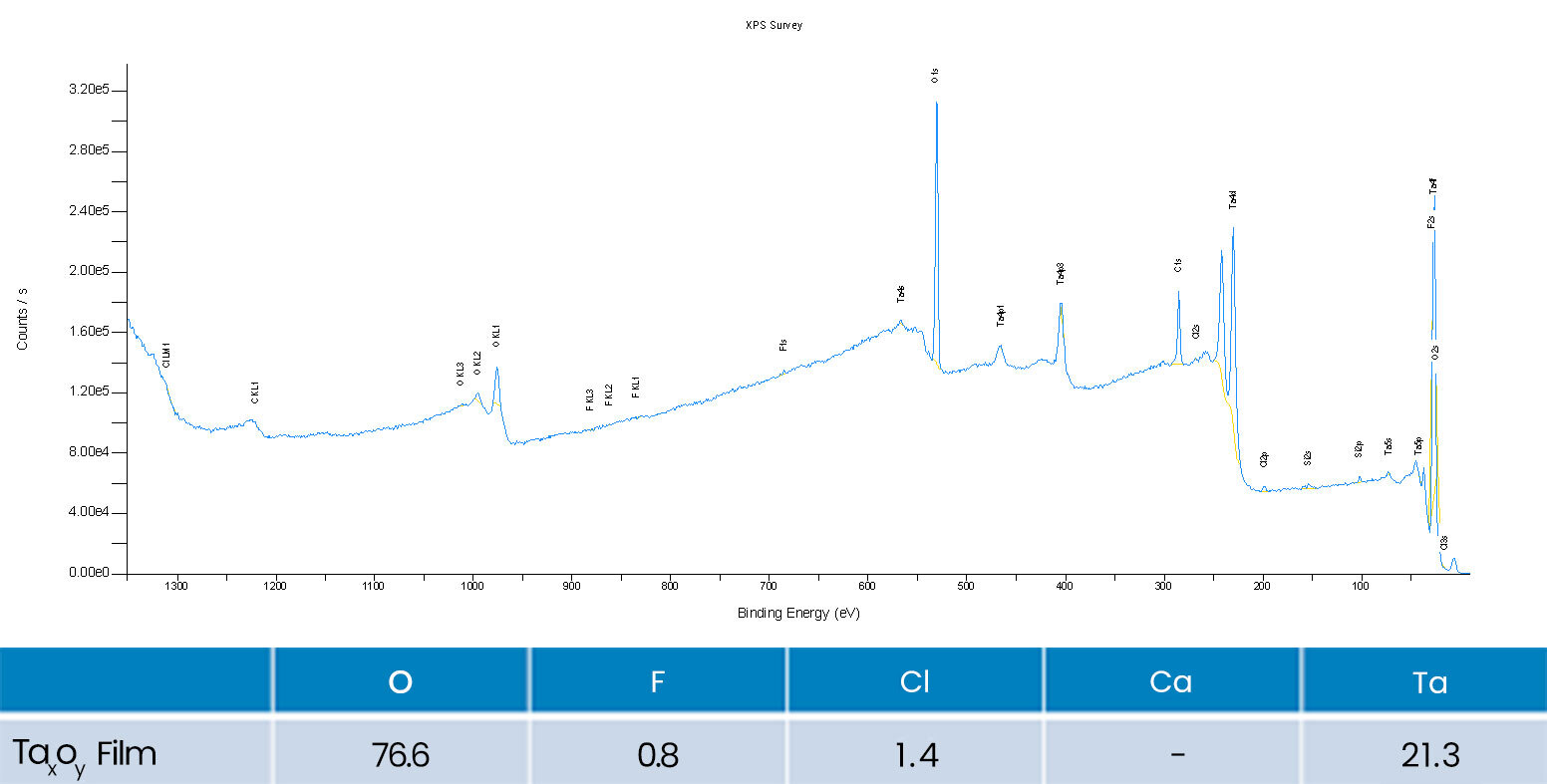
- XPS collects a survey spectrum over a wide energy range (-10eV to 1350eV) with high signal strength.
- Elements are identified by the detected peaks.
- Peaks are integrated to give the relative atomic percent of each element, normalized to 100%.
- Chemical Bonding Information:
- XPS takes high-resolution spectra focused on specific elements.
- These spectra use settings that enhance spectral resolution.
- Special models are used to fit each peak and determine their exact positions.
- The positions (binding energies) help identify what types of chemical bonds are present, using reference data.
- Depth Profiles:
- XPS can combine measurements with argon ion etching, which slowly removes material from the surface.
- This allows you to see how the composition changes with depth, useful for analyzing layered materials and estimating layer thickness.
- Angle-Resolved Analysis:
- By changing the angle of measurement, XPS can collect information from different depths without removing material.
- This helps estimate the thickness of layers in your sample.
High-Resolution Detection
Adjustable spot sizes (10–400 µm) and high spectral resolution for accurate surface characterization.
Advanced Sample Handling
Supports vacuum transfer, angle-tilt mounts, and work function measurements for versatile experiments.
Layered Material Analysis
Argon ion etching enables depth profiling to study composition changes across layers without losing chemical information.
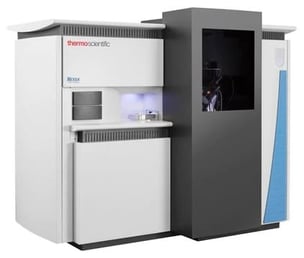
Equipment Used for XPS:
ThermoFisher Scientific Nexsa
- X-ray spot size: 10µ-400 µm.
- Detection limit: 0.1-1%.
- X-ray Source: Monochromated, micro-focused, high-efficiency Al Kα X-ray Anode.
Unsure Whether XPS Is Right for You?
Covalent’s mission is to level the playing field and ensure that clients of all backgrounds have access to data generated accurately. Get in touch and we’ll help create a solution for your specific needs.
Talk to an ExpertKey Differentiators
Strengths
Limitations
Survey spectrum of tantalum oxide film.
What we accept:
XPS can analyze any sample compatible with an Ultra-High Vacuum (10-9 mbar) including polymers, powders, cured adhesives, liquid residues, fibers, viscous oil and gels, and any other solid sample.- Solid phase.
- Stable under ultra-high vacuum conditions.
- Max dimensions: 60 mm (L) x 60 mm (W) x 20 mm (T).
- Flatter topographies improve signal detection.
- For Powder Samples: 5-10 mg is sufficient (as long as it can cover 0.5 cm x 0.5 cm of foil or Cu tape).
Why Choose Covalent for Your XPS Needs?
Learn More About Using X-ray Photoelectron Spectroscopy Today!
Contact Us